

Prayer and Spectacle
When is faith performative?

I don’t know if you like soccer, but I assume that you know it’s a big deal in the world right now. Soccer (football) has never been the sport with which I am most familiar, but I find the FIFA World Cup to be fascinating and I have embraced the spectacle, the sense of community, and the cheering on of our national team. It was with excitement that I attended, by invitation from a friend, a World Cup game here in Vancouver. We saw Canada versus Switzerland, in what has been voted the best host city.
We left without noticing what players were praying.
Whether you have been following the World Cup or not, you may have heard of some of the ways in which religion has shown up. One manifestation of faith has been the prayer circles that have formed after some games. In some instances, the circle is made up of players of one team. In other instances, the circle includes players from both teams. These circles subsequently give rise to some kind of social media shout-outs, often comments about how wonderful it is to see athletes demonstrating faith in such public ways.
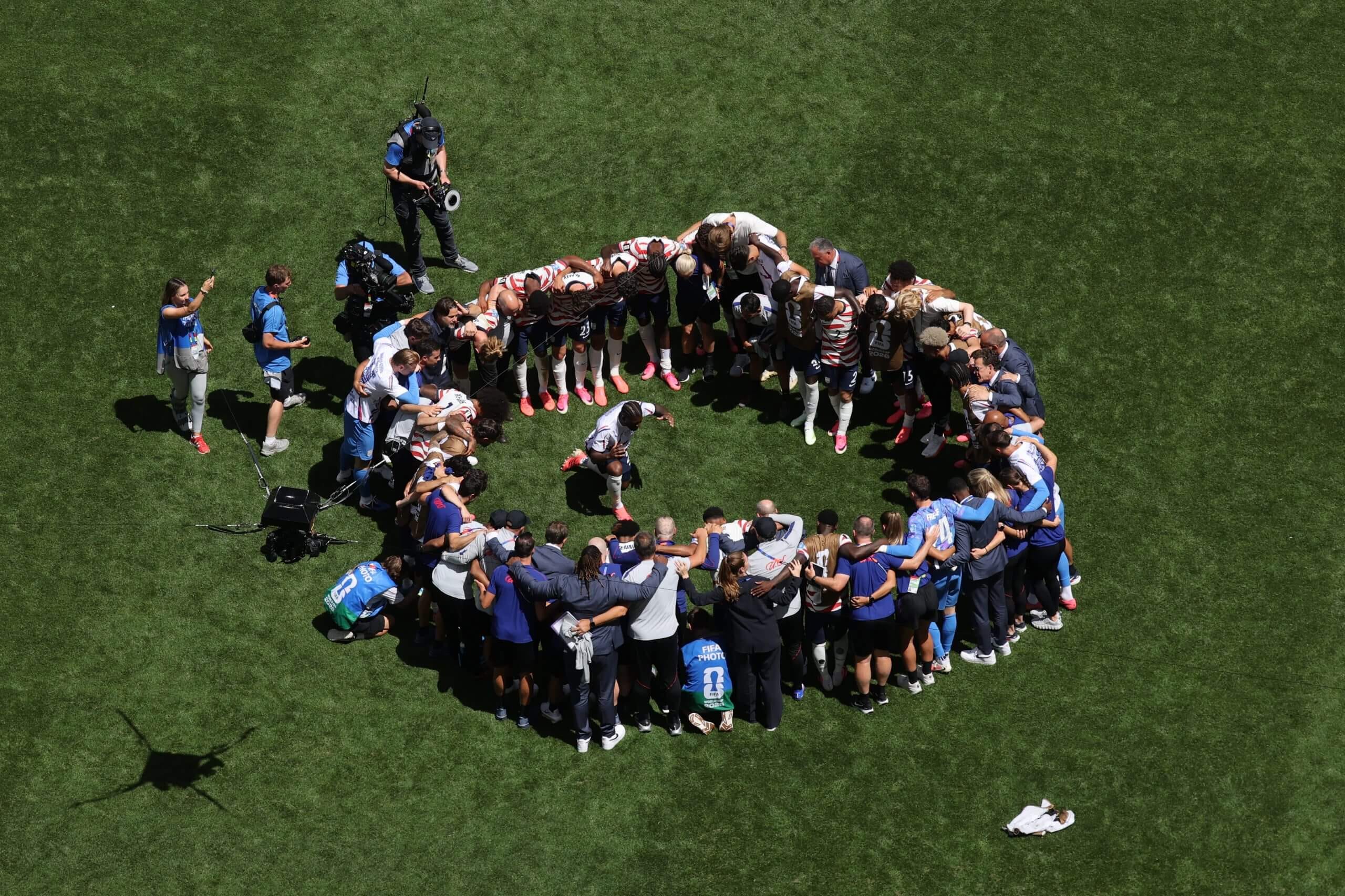
What do you make of all of this?
If you grew up in evangelical circles, you are aware of the almost automatic approval and even celebration of public displays of faith and devotion. Celebrities and athletes were affirmed for saying something like, “First of all I want to give all glory to Jesus…” in response to a reporter asking a question about how the game went or about the success of their recent movie or television show.
Were you among the many who celebrated such responses? Do you still?
Is it assumed that, if you are a Christian, you will have a positive reaction when you see such displays?
Have you felt something less than positive, perhaps conflicted or even negative?
Does that mean that you are less faithful? Or more?
It can be a curious and, at times, uncomfortable feeling to respond differently to some event or statement than the majority of your church or religious group. The very fact that you are reading Evangelically Departed might mean that you have occasionally found yourself saying “Well, hold on a second…” to something that is assumed to be Christian. If someone really loves those post-World-Cup-match prayer circles and has their faith bolstered by them, is it appropriate or helpful for you to express whatever consternation you may feel?
It is an important aspect of being part of a faith community, the ability to appreciate and even be grateful for how the faith of other people is edified and encouraged by things that don’t do the same for you.
So, maybe I can say it now—I don’t really love the post-game prayer circles. I don’t get why they take place on the field. They could take place away from the cameras, but there are, apparently, some reasons why ensuring public display is optimal for those participating.
You might recall the passage on prayer from Jesus’ longest sermon (the one on the Mount). As recorded in the book of Matthew, Jesus says, “And when you pray, do not be like the hypocrites, for they love to pray standing in the synagogues and on the street corners to be seen by others. Truly I tell you, they have received their reward in full. But when you pray, go into your room, close the door and pray to your Father, who is unseen. Then your Father, who sees what is done in secret, will reward you.”1
I am not aware of Jesus mentioning some kind of exemption to this direction in the case of professional sports or the FIFA World Cup.
Jesus was not always great at “using his platform”. There are actually multiple cases of Jesus, after healing someone, instructing them not to tell anyone about him. Can you imagine that?
There is a section in the collected sayings of the Desert Fathers and Mothers called “That Nothing Should be Done for Show”. Here is an example from the section:
“They said of Abba Arsenius and Abba Theodore of Pherme that they hated reputation and praise above everything. Abba Arsenius avoided people likely to praise him. Abba Theodore did not avoid them, but their words were like daggers to him.”2
I think that my consternation about public displays of religious devotion is heightened in times when Christian faith has been hijacked by movements of politics and power. When this context is present, even well-meaning actions can be marshalled towards divisiveness. Authentic religious devotion can be turned into a symbol for a government or a political or cultural movement. Politics as spectacle. Faith as spectacle. In the end, this is often about power.
However, just because I have a response of reservation to the prayer circles does not mean that I don’t see how they are encouraging to other people.
In the many years that I have been preaching in church, something occasionally happens that helps me through this tension. After a service, when I am greeting people, someone might gleefully remark on how much they liked the sermon. They might say something like, “Thank you so much. I really liked the sermon today. I especially liked it when you said…”. The trouble is what they say that I said is not, in my mind, accurate, at all, to what I intended to say in the sermon. In fact, they are making a point in opposition to what I said, taking the sermon to mean exactly what I hoped it would not.
Should I correct them, then? Sometimes, I suppose.
I don’t want people to think that I believe the opposite of what I believe. However, more frequently, I do not correct their impression. I do not seek to encourage it, but I, more or less, let it be. If they were to hear me preach consistently on other Sundays, then they would more clearly, I hope, see where I was coming from.
In the same way, even as I feel some reservation about the post-FIFA-World-Cup-game prayer circles, I can find my faith encouraged by something I don’t really like all that much. More specifically, I can find my faith encouraged by the people doing the praying.
One of the social media accounts that regularly features the prayer circles is called “Ballers in God”. My, often too quick, skepticism and sarcasm can be ignited by such names. I am not proud of this. When I searched for more information on Ballers in God I found two articles in The New York Times sports page, The Athletic. One focused on the recent prayer circle phenomenon and another offered a biography of the person who started Ballers in God. His name is John Bostock and he is a soccer player, himself. He was identified as an up and coming superstar when he was younger, but, like many players, his career has found him moving from team to team, country to country, league to league.
Here are some things that Bostock said that are noted in the article,
Whether you work in an office, on a building site, whatever…we all need the same things. We all need community, we need help and encouragement, we all feel emotion. But in this game, one minute you are on the highest of highs, the next you are…not.
My faith is the biggest thing in my life. It is who I am. As a kid, I was trained to think one way. I hear kids now say ‘football is life’. I get that. I understand it. But if football is life, what happens when it is gone? Are you dead?
Coming to know Jesus Christ…the Bible says he is the same yesterday, today and forever. He does not change. Football will always move around. A team will do well, it will do poorly, players will come and go. But my faith has been consistent. It is a rock I have built my life upon. Jesus changed my life.
And Mark McKenzie, a player for the United States who has led prayer circles at FIFA World Cup 2026, said that he hopes to pray in a way that is “as unifying as possible… to try to spread a message of love, to spread a message of peace.”
When I hear reflections like that my skepticism and consternation find some correction.
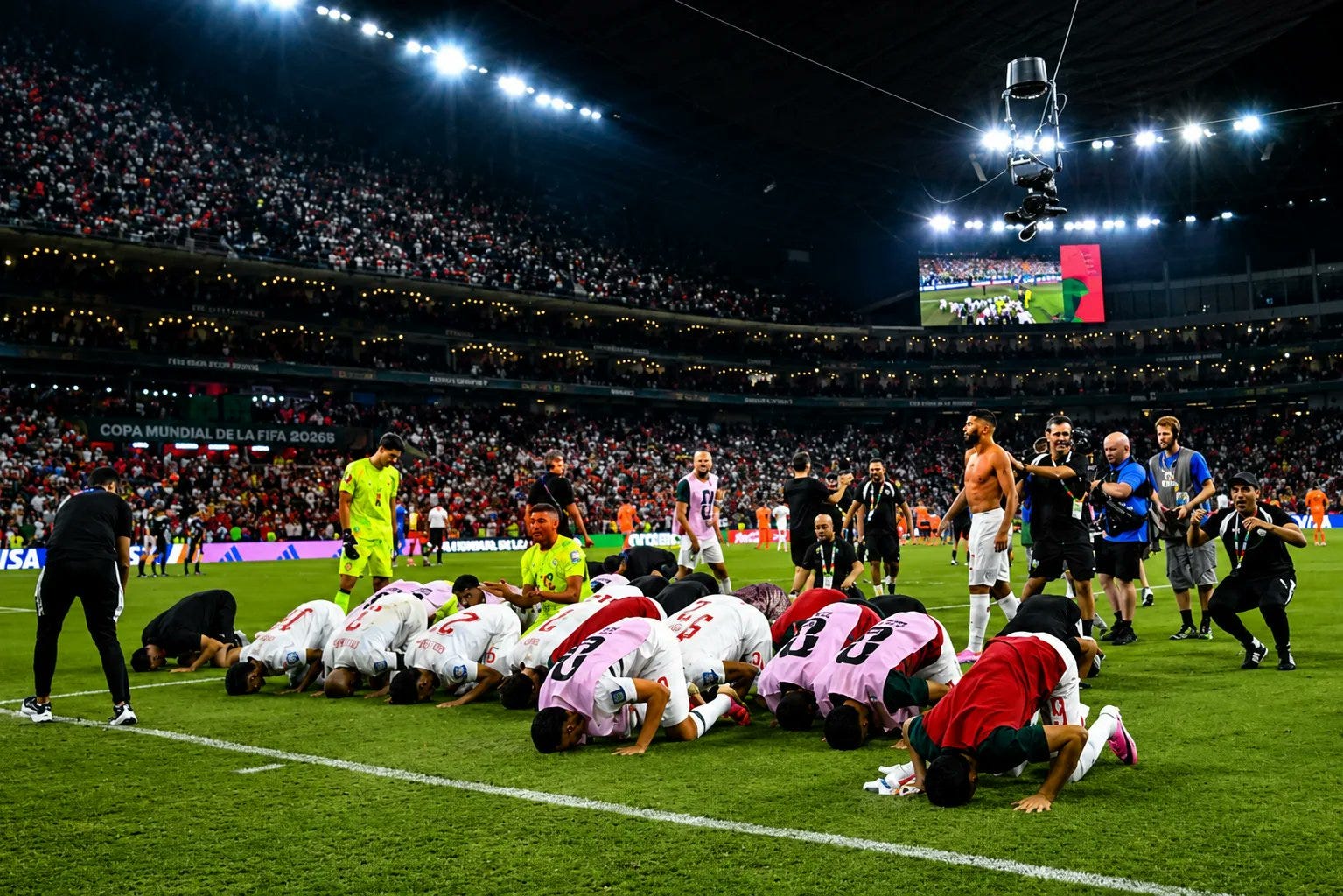
Perhaps, one way to think about how to most lovingly and charitably respond to the prayer circle phenomenon is to consider the prayers after matches by another team - that of Morocco. Many of the players on the Moroccan team move into the Sujood after the match has ended. This is the Islamic posture of prayer and prostration that is often taken up by people in formation. It is an act of prayer and humility.
If we are hoping to have a faith that is not defined by “us and them”, we will seek to hold gratitude not only for the Christian prayers, but for the prayers of other faiths.
There is no doubt that spectacle can be tempting. Maybe Jesus’ words about not praying in public can help us to see. However, I find myself grateful for the athletes and their apparent desire to consider what ultimately matters.
Enjoy the World Cup.
Matthew 6:5-6
P. 97 in Western Asceticism, The Library of Christian Classics, Ichthus Edition, 1979.
🙌🙌🙌 amen!!!